


Summarise with AI:



Automation in aviation is hardly a new phenomenon; it dates back over a century to 1912, when the Sperry Corporation built the world's very first gyroscopic autopilot. By 1930, the Royal Aircraft Establishment upgraded the concept with their "pilot's assister," and by the dawn of the 1970s, commercial jets routinely trusted auto-throttle systems to handle the engine's pulse. Today’s modern systems now run full diagnostics on the airframe, track global weather changes on the fly, and push flight safety and efficiency to historic highs.
As cloud IoT went mainstream, automation stepped into the cockpit as a silent, invisible wingman. But it was nothing like what we call automation today after the AI era.
The old way of automation across every industry was incredibly basic. It was kind of hardcoded logic. If X happens, then do Y. Binary and blind. Modern automation, with AI as a primary engine, doesn’t just run on fixed logic.
AI crushes massive data in seconds. Look at aviation: modern systems track a concurrent flood of data—weather spikes, turbulence, air traffic—and recalculate optimal flight paths on the fly.
Current technological advancements are radically redefining automation. However, believing it will totally wipe out human errors is unrealistic either. Aviation proves otherwise. The truth is that backend integration is incredibly brutal; an MIT study shows that 95% of generative AI pilot programs crash before they ever hit production.
If you are interested in understanding the root causes, we have already touched upon AI and data integration challenges in an article “Data Migration Guide for MRO Business Owners.” So, what’s the truth of aviation in modern aviation today? Let’s take a hard look at it.

What is Automation in Aviation?
Aviation automation relies on high-tier hardware and software to take over tasks that used to require a human touch.
The goal is simple: kill human error and boost efficiency. This evolution effectively shrinks the margin for human error and supercharges operational efficiency.
Today's systems combine top-tier hardware, mechanical components, smart avionics, sensors, and operational software, tracking vitals, and processing data streams, freeing pilots from handling every single manual detail by hand.
In aviation software development, automation is the use of electronic, mechanical, and software systems, sensors and avionics, operation software to carry out aircraft and airline tasks—like controlling the flight path, monitoring systems, and managing data—so humans don’t have to do every small step by hand.
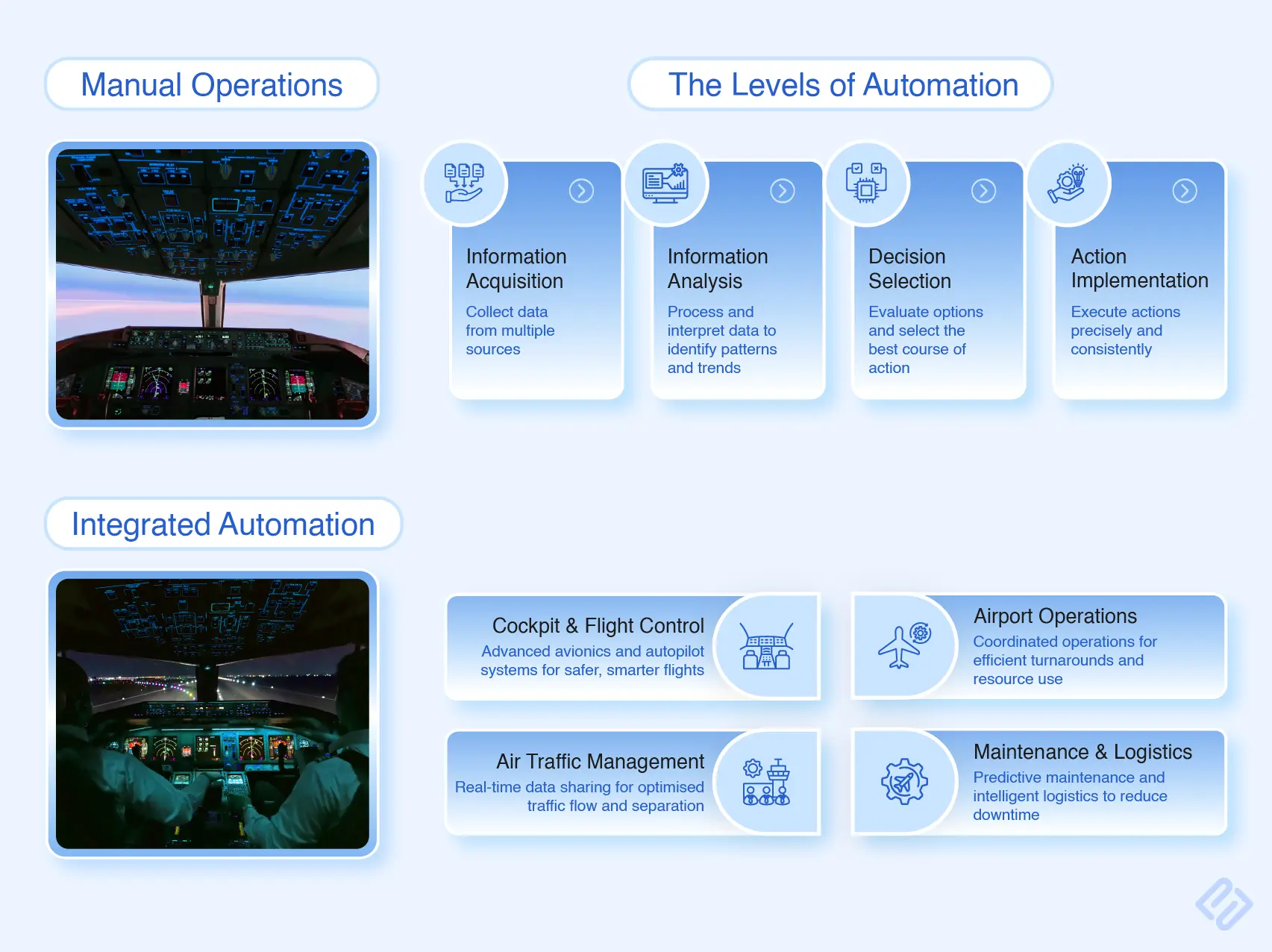
To be specific, modern aviation automation centers on these four core areas where practical deployment is happening today.
- Cockpit and flight control
- Air traffic management
- Airport operations
- Maintenance and logistics
1. Cockpit and flight control
These systems automate flight path computation and provide immediate alerts of resolution, leveraging technologies such as machine learning, and computer vision.
2. Air traffic management (ATM)
Beyond the aircraft, AI is playing a big role in air traffic management. AI assistant helps air traffic controllers maintain situational awareness. These systems can process data from thousands of aircraft simultaneously.
3. Airport operations
AI-driven digital twins like those used at London Heathrow and Copenhagen automatically reassign gates and ground equipment during delays, reducing aircraft turnaround time. AI with Internet of Things enables companies to create an environment where thousands of sensors track like queue lengths, air quality. These AI models adjust operations dynamically.
4. Maintenance and logistics
Maintenance and logistic automation goes beyond basic automation and includes systems that self-regulate using advanced artificial intelligence algorithms. Similar to how AI models are used in other areas, they are employed to analyze data like machine vibrations, temperature changes, and wear-and-tear on parts.
In fact, predictive maintenance (PdM) is considered one of the most critical and highly sought-after digital capabilities in 2026 within major industries, especially within manufacturing, logistics, and asset-heavy industries.
Popular Use-Cases of Automation in Aviation
A modern aircraft can contain from 20,000 to 25,000 built-in sensors that transmit and receive information all the time. In 2026, almost 58% of the large commercial carriers feature sensors with intelligent software systems that can predict engine and hydraulic breakdowns ahead of time. Moving away from hands-on checks to non-stop digital tracking is totally changing how planes stay in the air. Here is exactly where this tech is making a difference.
1. Flight Operations
The annual losses due to delayed flights have been estimated at around $30-$40 billion per year in the USA alone.
In Europe, weather-related delays now account for close to a third of all air traffic flow management delay minutes, adding up to tens of thousands of hours of extra flying and waiting each year.
A modern flight management system analyzes the real-time data on winds, weather, and traffic in order to find the optimal route and flight profile. It determines the optimal flight speed, altitude, and fuel consumption.
2. Air Traffic Control
Modern ATC systems include conflict detection and trajectory prediction modules. On approach and departure, automation helps build stable sequences to and from the runway, reducing the cognitive load. It uses aircraft type, speed, wake turbulence category, and runway constraints to propose spacing that reduces last‑second speed changes and go‑arounds. For operators, these tools also make traffic flow more predictable.
3. Aircraft Maintenance
In 2019, the total annual cost for flight disruptions – delays and cancellations combined – in the US reached an estimated $33 billion. A lot of that pain comes from reactive or unplanned maintenance. Automation sustains better accuracy, free from the natural wear and tear that gradually slows human hands and minds.
The system uses existing data—tech logs, reliability reports, and historical faults—to flag components or systems that are likely to cause trouble.
4. Passenger Experience
Roughly 80% of global airlines benefit from automation in key services. One example of such is self-check-in. Delta Air Lines use RFID tags and automated scanners to track luggage at multiple points – from check-in to arrival.
The use of RFID automation improved baggage loading rate by 10%, reduced mishandled bags by 13%, and cut baggage‑handling injuries by 21%, Delta reports.
5. Ground Operations
At airports, the impact of automation is visible in routine groundwork. Tasks like baggage loading, pushback, and even aircraft cleaning are no longer fully manual. Automated or semi‑automated equipment, like Robotic or sensor‑guided loaders and tugs, are taking care of repetitive lifting and movement.
Airlines now let their operational systems send flight updates directly to passenger apps, SMS, and airport screens as soon as something changes via automated systems. Gate changes, delays, and boarding calls are triggered via automated systems through mobile apps, SMS, and airport screens.
6. Revenue Management
Many airlines have automated revenue management systems. The system automates the dynamic fare process by analyzing bookings, remaining capacity, and competitor pricing—in real time.
Airlines feed these systems real-time data on everything such as route performance, no-and show rates, harvesting a few extra points of revenue – effortlessly.
7. Regulatory Compliance
Look at regulatory compliance. Take a standard part delivery, like an engine blade. Traditionally, when that serialized part hits the hangar floor, a QA inspector has to dig up the FAA Form 8130-3 or EASA Form 1, scan the PDF, double-check the references, and type everything into the database by hand.
Automated process is the second a supplier uploads that form; the system automatically pulls the part, serial, and certificate numbers. From there, it immediately runs the data through pre-set validation rules.
This is how companies are protecting themselves from the billions of dollars lost globally to simple human mistakes.
8. Customer Support
Air India has developed a custom AI chatbot, 'AI.g,' a first point of contact for customer service. It reportedly handles 97% of customer queries with no human intervention. Systems such as Timatic AutoCheck from IATA can verify docs like passports and visa within milliseconds. Then, intelligent chatbots and virtual assistants' cover repetitive inquiries related to flight status, baggage policies, and refund requirements.
9. Supply Chain Management
Aviation spare parts are a total balancing act. If you buy too many, valuable cash is trapped in a warehouse. But if you under-buy, a single missing bolt can ground a plane. Automation makes inventory tracking a total walk in the park by enabling predictive ordering, round-the-clock tracking of any number of items.
Lufthansa Technik is one of the most prominent real-world examples of this system working in tandem. Their flagship digital platform, Lufthansa Technik AVIATAR, uses machine learning to look at real-time sensor streams from flying aircraft.
Through Lufthansa Technik Logistik Services (LTLS), they deployed low-code automation tools (specifically SAP Build Process Automation). This system captures those predictive failure signals, hooks into their material logistics, and automates data entry and part transport bookings across their systems.
Benefits of Automation in Aviation
- Time and Cost Efficiency Automation removes many manual steps, leading to time and cost savings. One ability which we have earlier discussed is route optimization. The tools can analyze a concurrent stream of data emitting from countless numbers of devices without biological or mental breakdown.
- Reduced Workload Systems now handle routine tasks that once needed constant attention. During phases of flight autopilot manages basic control. This gives pilots space to monitor systems, weather and traffic. They do not have to control everything all the time.
- Reduction of Error Human errors – unavoidable - cost businesses over $3.1 trillion annually in lost revenue worldwide. Automation is a powerful way to mitigate errors stemming from inaccurate manual data entry.
- Improved Quality of Response When the situation is chaotic, you need speed and total clarity. Automated monitoring and instant alerts catch anomalies. It cuts right through the uncertainty, allowing professionals stay in sync.
- Competitive Advantage Let’s face it. Passengers trust airlines that maintain ironclad operational discipline. Automation helps you build that kind of discipline required to stay competitive. It helps reduce flight delays and turnaround times. This is what you need to build a industry reputation over time.
- Improved Decision‑Making Automated tracking software can crunch massive data in seconds. This provides managers with the insights to make strategic calls. Stepping in early means you prevent massive knock-on effects later in the day.
Disadvantages of Aviation Automation
Automation also introduces challenges that airlines and airports must manage carefully.
- Operational Disadvantages A glitch can ripple across your operations in seconds. Technology works beautifully until it meets an edge case—like an abrupt mechanical failure or a sudden, massive spike in traffic. When those unpredictable situations hit, software often chokes.
- Back Office Disadvantages Automation is fantastic at generating data, but it also creates an absolute mountain of information that requires constant human oversight. Without aggressive strict guardrails, that ocean of telemetry will choke your workflows. Instead of accelerating operations, engineering teams may end up being under false alarms.
- Risk of Overreliance Over-reliance on automation may gradually erode a pilot’s situational awareness. In case the flight process proceeds smoothly without any intervention from the pilot due to automation, there is a possibility of the crew falling into passive monitoring mode. In an event where a complicated emergency arises, pilots who depend on system navigation take a little extra time to react manually.
- Automation Dependency The reliance on automation makes one vulnerable to huge gaps whenever there is a failure of the system. If a cockpit crew has spent months simply watching screens with very little hands-on flying time, suddenly taking manual control of a malfunctioning aircraft becomes a massive mental and physical hurdle.
- Risk of Human Error Automation never actually takes humans out of the equation but merely relocates their position. It is always the human who designs the system architecture, writes the code, and uses tools to keep the machinery running. If a programming error is made or if the technician sets something incorrectly, then the latent problem remains hidden until the system fails spectacularly.
Conclusion
Let's be realistic: automation is no longer a futuristic goal; it is a daily working reality of digital transformation in aviation. If used effectively, it becomes a huge multiplier of safety, ensures that operations cost are completely predictable, and eliminates any uncertainty from daily schedules. Passengers will enjoy the benefit of real-time information and hassle-free airport experience, while the airline hubs will be able to get a complete picture of their operations.